

California Air Resources Board (CARB) Agricultural Vehicles and Regulatory Programs
There are many CARB regulatory programs that overlay with the state’s agricultural industry. The programs include, but are not limited to, CARB’s Bus and Truck Rule, and several pending draft regulations related to Advanced Clean Fleet (ACF), Advanced Clean Truck (ACT), Heavy Duty Inspections and Maintenance (HD/IM), among others. Please note that this information does not, at this time, contain compliance related details for ACF, ACT nor HD/IM as these regulations may undergo additional modifications before final adoption by CARB.
The overview provided is not intended to be a detailed analysis of a regulation’s applicability to agriculture but is, instead, a means of identifying and familiarizing members of Farm Bureau with the various emission reduction programs that they may encounter.
Truck and Bus Regulations
The California Air Resources Board (CARB) approved the Truck and Bus regulation in December 2008 and has made several major changes since that time. The information provided below first describes the rule as it applies to agricultural vehicles and is followed by basic general compliance information about the truck and bus rule.
There are numerous other compliance options beside the Agricultural Mileage provision. The options listed below are the ones most commonly used by the agricultural community but, as noted, only a few of them are still available. If none of these compliance options fits your needs, general compliance information about the truck and bus rule using the engine model schedule is included.
- Agricultural Mileage Extension—Closed to registration as of January 31, 2015.
- Low-Use Vehicle Exemption—Still available.
- NOX Exempt Option—Still available for limited trucks.
- General Engine Model Year Compliance Schedules for Light and Heavy Trucks.
For addition information, fact sheets, compliance tools and regulatory documents about the Truck and Bus Regulation these are accessible online at https://ww2.arb.ca.gov/our-work/programs/truck-bus-regulation/truck-and-bus-regulation-fact-sheets
Agricultural Mileage Extension - *Closed as of January 31, 2015*
If you registered your agricultural vehicles with CARB before January 31, 2015, and have
provided annual mileage to the agency by January 31 of each year, you can continue to use this
extension until January 1, 2023, at which time you are required to have 2010 engines for on-road
diesel vehicles 14,000 gross vehicle weight rating (GVWR) and greater.
The Agricultural Vehicle extensions delays compliance for agricultural vehicles that operate less than
specified mileage thresholds and for a limited number of specialized vehicles. The extension applies to
diesel vehicles with a GVWR greater than 14,000 pounds that are exclusively use for agricultural operations. It includes agricultural vehicles such as trucks and buses owned by log harvest operations or farming businesses and certain trucks that are not farmer-owned but are dedicated to supporting agricultural operations. Pickups are not subject to the regulation.
Only vehicles that operate less than 10,000 miles every year can continue to have the extension until
January 1, 2023. Owners must update their odometer reading in January of each year and when a vehicle is removed from the fleet. The extension expires immediately when a vehicle exceeds the mileage limits in any year or if it is used for non-agricultural purposes. Once the agricultural vehicle extension expires for any specialty vehicles or one using the mileage extension, they must be upgraded to a vehicle with a 2010 or newer mode year engine or claim any remaining flexibility options the vehicle
may be eligible to use.
Again, the Agricultural Mileage Extension opt-in has since expired and is no longer accepting vehicle enrollment.
Low-Use Vehicle Exemption – Still Available
A low-use vehicle (does not include school buses) is one that operates fewer than 1,000 miles per
calendar year within California’s borders. Vehicles which meet the annual mileage limits will be exempt from PM filter or engine-upgrade requirements in any calendar year but annual odometer and hour meter reporting is required.
To enroll in the Low-Use Vehicle Exemption, each January an individual can designate which trucks will use the low-use exemption for the year. Individuals must report vehicle information, odometer readings, and hour meter readings if applicable by January 31 of the compliance year or within 30 days of purchasing a vehicle. Individuals must also report end of year odometer readings and when the vehicle is sold to demonstrate the vehicle met the mileage limits. Individuals must also keep records of odometer readings, hour meter readings if applicable, vehicle purchases, and sales.
Any vehicle that has exceeded the low use mileage or hour limit thresholds is no longer eligible to use any flexibly option in the regulation. Additionally, the vehicle will need to be brought into immediate compliance with the engine model year schedule by either retrofitting or replacing the vehicle depending on the model year of the engine in the vehicle.
NOx Exempt Option – Still Available
This summary describes compliance options for vehicles that are operated solely within defined
NOx Exempt Areas in California. Vehicles that operate exclusively in areas defined as NOx Exempt Areas and have a PM filter installed do not need to be replaced. Each January, or within 30 days of purchasing a vehicle, owners must report fleet information and identify which vehicles will operate in NOx Exempt Areas to take advantage of the extensions.
The following counties (shown in the darkly shaded areas) make up the NOx Exempt Areas: Alpine, Colusa, Del Norte, Glenn, Humboldt, Lake, Lassen, Mendocino, Modoc, Monterey, Northern Sonoma, Plumas, San Benito, San Luis Obispo, Santa Barbara, Santa Cruz, Shasta, Sierra, Siskiyou, Tehama, Trinity, and Yuba.
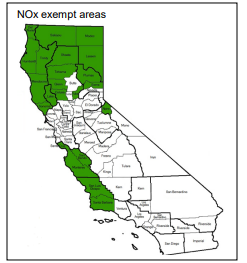
Vehicles with 1996 to 2006 model year engines that have a PM filter (OEM or retrofit) may operate throughout California until replacement is required per the Engine Model Year schedule. Once replacement is required, a vehicle with a PM filter will be exempt from the replacement requirement if the vehicle does not leave the NOx areas and is reported. Any vehicle already required to be replaced per the Engine Model Year schedule requirements (such as lighter vehicles or heavier vehicles with
1995 and older model year engines) must already have a PM filter and remain exclusively in the NOx
Exempt areas. You will need to report your vehicle as “NOx Exempt with a PM Filter”.
Vehicles that are designated as NOx Exempt, must have permanently affixed or painted labels on the
left and right door with the letters “NE” in three-inch white block letters on a five inch by eight-inch black background, unless the owner chooses to comply by using a vehicle location tracking system. The labels must be in clear view at all times. ARB will not issue the label.
General Engine Model Year Compliance Schedules for Light and Heavy Trucks
This summary describes the compliance requirements and options available for vehicles that operate in
California. There are different requirements based on the weight category of your vehicles.
The Truck and Bus regulation affects individuals, private companies, and Federal agencies that own
diesel vehicles with a Gross Vehicle Weight Rating (GVWR) greater than 14,000 lbs. that operate in
California. The regulation also applies to publicly and privately owned school buses; however, their
compliance requirements are different and reporting is not required. The regulation does not apply to
state and local government vehicles and public transit buses because they are already subject to other
regulations. Vehicles that are exempt from other heavy duty diesel regulations, such as Cargo Handling
Equipment, Drayage Truck, and Solid Waste Collection Vehicle regulations, may be subject to the Truck
and Bus Regulation (regulation). Drayage and solid waste collection trucks with 2007 to 2009 model year engines must meet the requirements of the regulation by January 1, 2023.
Heavier trucks and buses with a GVWR greater than 26,000 pounds must comply with a schedule by
engine model year or owners can report to show compliance with more flexible options. All heavier vehicles with 1996 or newer model year engines should have a PM filter (OEM or retrofit). Vehicles with
1995 model year and older engines should have been replaced by January 1, 2015. By January 1, 2023, all trucks and buses must have 2010 model year engines with few exceptions. No reporting is required if complying with this schedule.
Lighter trucks and buses with a GVWR of 14,001 to 26,000 lbs. have replacement requirements starting January 1, 2015. The Engine Model Year Schedule for Lighter vehicles shown in the table to the right lists the compliance dates by engine model year for existing lighter trucks. Starting January 1, 2015, lighter vehicles with engines that are 20 years or older must be replaced with newer trucks (or engines). Beginning January 1, 2020, all remaining vehicles need to be replaced so that they all have 2010 model year engines or equivalent emissions by January 1, 2023. No reporting is required with this schedule.




.svg.png?cacheid=0.9616018850896426)
